Around 8:49 a.m. on October 11, a participant in the half-marathon event of the 2026 Seoul Marathon suddenly collapsed and lost consciousness at the 20.6-kilometer mark. After receiving emergency treatment at the scene, the runner was taken by ambulance to a medical facility, but unfortunately died.
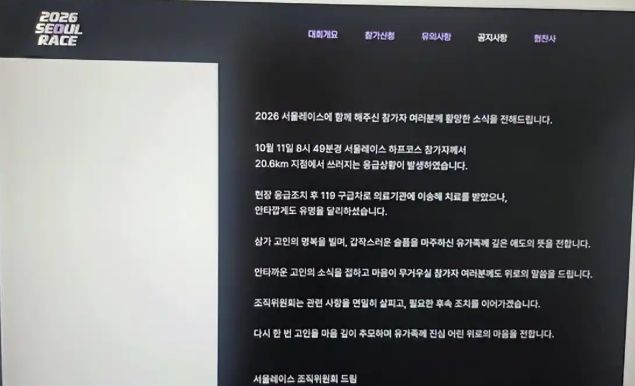
Screenshot of the organizers’ statement
The organizers said: “May the deceased rest in peace, and please accept our deepest condolences as you suddenly face this devastating and shocking news.”
In its announcement, the organizing committee reconstructed what happened: The half-marathon participant suddenly lost consciousness and collapsed about 500 meters from the finish line. Medical personnel immediately performed CPR and provided emergency treatment, but the participant never regained consciousness. She was subsequently taken to hospital and died that day.
According to South Korean media reports, Liu Zhi-won, who was second in the women’s race at the time, was closely following the leading pack. With just 497 meters to go, she collapsed…
The sudden tragic news came as a devastating shock to fans, who flooded her social media accounts with messages such as: “I hope you have no illness in heaven and live a happy life.”
A fellow trainee also posted: “I can’t believe she’s gone.”
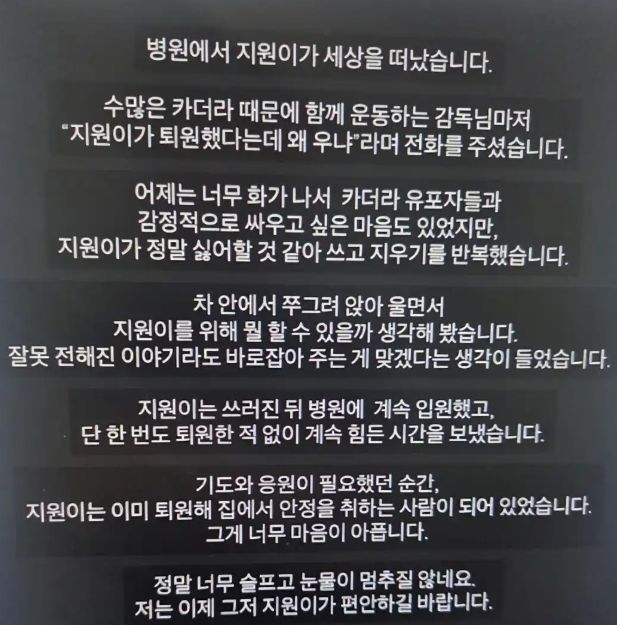
Many fans flooded her social media accounts with messages
Liu Zhi-won was reportedly a graduate student at the Korea Advanced Institute of Science and Technology (KAIST), one of South Korea’s top universities, specializing in AI semiconductors.

Liu Zhi-won was a graduate student at KAIST

A photo from her life posted on social media
Her social media accounts show that she had been passionate about long-distance running since 2022 and was a highly accomplished amateur runner.

Liu Zhi-won had participated in numerous races
Just this March, she completed the full 2026 Seoul Marathon in 2 hours, 56 minutes and 32 seconds, successfully breaking the three-hour mark and achieving a “sub-3” finish.


In March, Liu Zhi-won completed the full 2026 Seoul Marathon in 2 hours, 56 minutes and 32 seconds
From breaking three hours in the full marathon in March to collapsing on the half-marathon course in October, little more than half a year had passed.
The organizing committee did not disclose further information about the deceased’s identity. Subsequent reports confirmed her name and background. The event organizers have expressed their condolences, but have not yet provided further details about their next steps.

The event organizers have expressed their condolences
Consider these issues before challenging yourself
A marathon is not an event where you can simply “start running as soon as you put one foot in front of the other.” Before actually entering a race, everyone should first ask themselves: “Am I really suited to running a marathon?” Whether you are an experienced runner or a beginner, confirming that you are prepared before exercising is the first step toward running safely.
According to statistics from international sports organizations, people who receive medical attention for various reasons during races account for 20%–25% of all participants. Being a regular runner with the ability to run does not mean you are immune to various injuries and illnesses, including heart disease. The American running magazine Runner’s World once invited sports medicine experts to list “several groups of people who should not run.” Even runners with excellent running abilities face a high risk of injury or even sudden death if they fall into any of these groups.
First are people with severe heart disease.
Running causes a runner’s heart rate to increase and raises the body’s oxygen consumption, making it easy to become short of breath. People with heart disease should avoid sudden excitement; if their heart rate rises too quickly, something can easily go wrong. Therefore, people with severe heart disease are advised not to participate in marathons, to avoid accidents.
Second are people with cardiovascular disease.
Running requires a large amount of oxygen and uses carbohydrates, fat and protein to provide energy for the body. As running speed and heart rate increase, the amount of blood pumped by the heart also rises. This places a burden on the heart and blood vessels and increases the risks for people with cardiovascular disease.
Third are people with diabetes.
People with diabetes should not run immediately after injecting insulin, in order to avoid hypoglycemia. People with severe diabetes should also avoid running when they have not injected insulin or when they have a fever caused by an acute infection. At such times, insulin levels in the body are low, and glucose cannot meet the energy demands of running, so the body consumes large amounts of fat to fuel the exercise. The resulting fatty-acid metabolites may cause poisoning.
Fourth are people with gout.
Running carries certain hidden dangers and risks for people with gout. Increased sweating reduces blood volume and renal blood flow, while decreasing the excretion of uric acid, creatine and other substances. This can easily lead to hyperuricemia and may also trigger gouty arthritis. The best forms of exercise for people with gout are brisk walking or aerobic exercise, and activity should not be too strenuous. If planning to exercise for an hour, they should stop and rest once every 15 minutes of activity and drink water to replenish fluids, then resume activity for 15–20 minutes after resting for 5–10 minutes. Dividing an hour into three stages in this way helps avoid excessive intensity and duration.
Running after a cold or a sleepless night is a major exercise taboo.
Many runners develop “blind confidence” in their athletic ability and physical condition. For example, after passing the routine medical examination required before a marathon, or after occasionally having a mild cold or staying up late, they may assume that their physical condition is still fine. In reality, however, this is often the “most dangerous moment” for running.
Lu Le, founder of First Response, an organization specializing in emergency medical care at marathons, told The Paper that after investigating people they had previously rescued, his team found that the vast majority of runners who suffered emergencies did not actually have severe heart disease and did not even need medication. Yet they became part of the small number of people who collapsed while running.
“Many people think that a cold, heatstroke or diarrhea is not a serious problem, and that enduring it will not affect their training or race. Some people are even diagnosed with an irregular heartbeat during a medical examination but still insist on running—and then something happens.” In Lu Le’s view, these minor symptoms are actually extremely dangerous, and failing to take them seriously before running can be fatal. “Cardiac arrest can be caused by electrolyte imbalance, overexertion, intense emotional fluctuations, medication side effects, heart disease and other factors. Diarrhea and heatstroke can cause electrolyte imbalances, which can exacerbate cardiac arrest during intense exercise; viral colds, meanwhile, can trigger myocarditis during strenuous exercise.”
Athletes should not decide whether they are fit to participate in a race based simply on whether they can complete a half or full marathon. Instead, they should use more scientific exercise metrics to arrange their training and races more rationally.
Running may be an exercise with no strict entry requirements, but if you want to run healthily and safely, it ultimately does have prerequisites: scientifically designed training and respect for life. Before deciding to participate in a marathon, the first thing to remember is that the true finish line is getting home safely.
